
Key takeaways
- Permission route: Marine Drive promenade filming needs A-ward permission.
- Unit logistics: Sunday mornings offer empty streets and clean skylines.
- Reference landmarks: NCPA, Air India Building, Marine Drive.
- Cost impact vs the Mumbai average: minimal on rates, material on lost time if access is unplanned.
01
What Nariman Point is actually like to shoot in
Legacy corporate Mumbai: law firms, banks and listed company boards. For a production unit that translates into a specific set of practical conditions rather than an abstract character: sunday mornings offer empty streets and clean skylines. Anyone planning a day here should treat those two sentences as the schedule's real constraint, ahead of anything on the shot list.
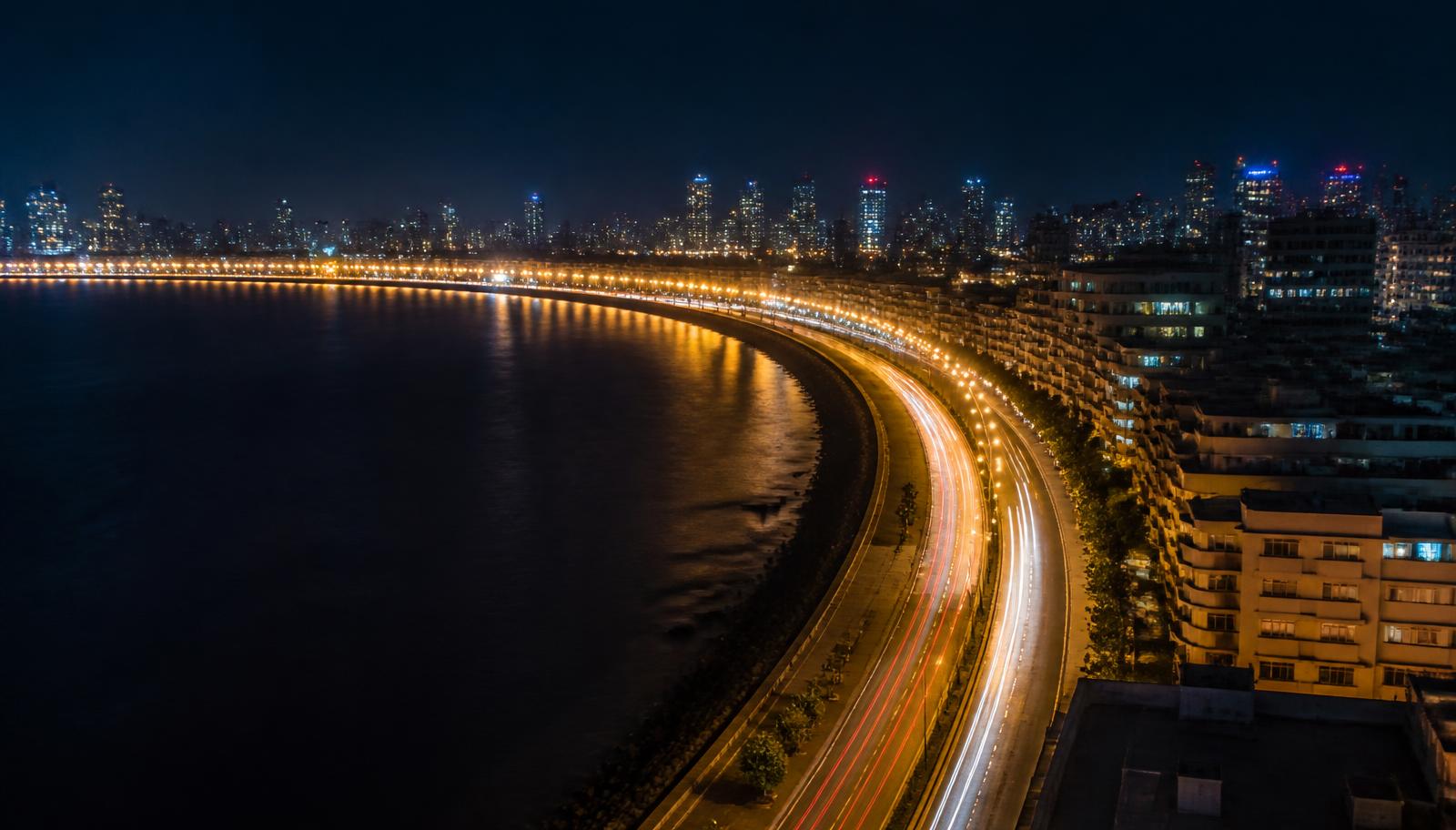
Establishing context is easy in Nariman Point — NCPA, Air India Building, Marine Drive all read instantly on camera and place the film geographically in a couple of seconds. The temptation is to over-use them. A single well-chosen establishing frame does the job; three of them turn a corporate film into a tourism reel.
The other local factor is noise. Mumbai exteriors carry traffic, construction and crowd noise at levels that ruin usable dialogue, which is why we record clean interview audio in a controlled interior and use exteriors for visual context rather than for sync sound, unless the brief specifically calls for street-level realism.
- Zone
- South Mumbai
- Pincode
- 400021
- Permission route
- Marine Drive promenade filming needs A-w
- Nearby areas covered
- 6
02
Permissions: who issues what, and how long it takes
Marine Drive promenade filming needs A-ward permission. Filing happens in week one of the project, in parallel with scripting, because the approval is the only element of a Mumbai shoot that cannot be compressed by working harder.
Interiors on private property — offices, showrooms, factories, studios — need the property owner's written consent and, in most managed buildings, a facilities booking for the service lift and loading bay. That second item is skipped more often than any other and is responsible for more lost shoot hours in Mumbai than weather.
Anything airborne needs DGCA compliance and, in this part of the city, sensitivity to the flight path and to any defence or port restrictions nearby. We file drone clearances separately and earlier than ground permissions, and we always plan a ground-level alternative for the same shot.
| Type of access | Issuing authority | Typical lead time | Notes |
|---|---|---|---|
| Private office / interior | Property owner + facilities | 2–5 days | Book service lift and loading bay in writing |
| Housing society common area | Society managing committee | 5–10 days | NOC usually required; fees vary widely |
| Public road / footpath exterior | Municipal ward office / police | 10–21 days | Traffic-sensitive locations need police coordination |
| Industrial estate | MIDC / estate office | 7–14 days | Gate pass and safety induction per crew member |
| Heritage or institutional property | Trust / institution | 14–30 days | Access windows and equipment restrictions common |
| Aerial / drone | DGCA + local authority | 10–21 days | Zone dependent; plan a ground-level alternative |
Indicative Mumbai lead times. File in week one regardless of the shoot date.
03
A realistic shoot day in Nariman Point
Call time is set against the local movement pattern, not a generic morning start. In South Mumbai that means staging gear the previous evening where the rental house allows it, and getting the unit in before the peak build-up rather than fighting through it with a truck.
Sunday mornings offer empty streets and clean skylines. Unit basing decides how much of the day is spent moving equipment rather than shooting, and it is worth walking the route from parking to set during the recce — including the lift, the stairwell and any security checkpoint — with the heaviest case you intend to bring.
Wrap includes an on-site backup pass. Cards are cloned to two separate drives before anyone leaves Nariman Point, one of which travels with a different person. A selects reel goes out the next working morning so the client sees the material while the shoot is still fresh.
- 1
06:30
Gear collected; unit moves ahead of the peak traffic build-up
- 2
07:30
Unit base established, cable runs and power confirmed with facilities
- 3
08:30
Lighting and camera set; talent briefed; sound checked in the room
- 4
09:30
Principal photography — interviews first while energy and light are best
- 5
14:00
B-roll, cutaways and exteriors using the approved landmark frames
- 6
17:00
Wrap, on-site card clone to two drives, dedicated equipment de-rig

04
What a shoot here costs
Crew and equipment rates in Nariman Point are the same as anywhere in Mumbai — the market is city-wide. What varies is the area-specific line items: permission fees, parking, any estate or society filming charge, and the labour cost of a difficult unit move. We quote those as visible items rather than folding them into a day rate.
The larger financial variable is time. An access problem that costs two hours on a single-day shoot removes roughly a quarter of the available shooting time, and that is far more expensive than any permission fee. This is the entire argument for the recce.
| Format | Typical timeline | Budget band |
|---|---|---|
| Green Screen Video Production | 2-3 weeks | Rs 90K - Rs 7L |
| Video Production Agency Services | Annual retainer | Rs 15L - Rs 1.2Cr per year |
| CSR Video Production | 4-8 weeks | Rs 2.5L - Rs 16L |
| Corporate Video Production | 3-4 weeks from brief to master | Rs 3.5L - Rs 18L |
| Brand Film Production | 5-7 weeks including casting | Rs 8L - Rs 45L |
| TV Commercial Production | 6-10 weeks | Rs 25L - Rs 2Cr |
05
Nearby areas covered from the same unit base
A crew based in Nariman Point can reach the following without a second travel day, which matters when a project needs multiple sites on one budget. Scheduling two nearby sites into one day is usually cheaper than two half-days a week apart.
- Fort (400001) — Pedestrianised pockets suit compact gimbal units.
- Colaba (400005) — Early call times before 7am avoid crowd control issues.
- Byculla (400027) — Wide older streets support full technical units.
- Mazgaon (400010) — Elevated garden views over the eastern waterfront.
- Cuffe Parade (400005) — WTC has structured filming and load-in procedures.
- Churchgate (400020) — Art deco frontages within a 500m walk.
06
How to measure whether it worked
Most video budgets in Mumbai are approved without a success metric, which is why the second film is always harder to get signed off than the first. Decide the number before production starts and instrument for it: view-through rate at 25, 50 and 75 per cent tells you where the script loses people; click-through and assisted conversions tell you whether the proposition landed; and for internal work, completion rate against a training or onboarding cohort is the only figure that matters.
Set the benchmark honestly. A Nariman Point video asset placed on a landing page above the fold behaves nothing like the same cut running as paid social, and comparing the two produces a false conclusion. We publish expected ranges with the delivery so the marketing team is not benchmarking a 90-second explainer against a six-second bumper.
Review at 30 days, not at launch week. The first week's numbers are dominated by internal traffic and paid burst spend. The 30-day picture is what tells you which cutdown to fund next, which thumbnail to replace, and whether the opening ten seconds needs a re-edit — a cheap fix that regularly doubles retention without a reshoot.
- 15s social cutdown78%
- 60–90s explainer54%
- 2–3 min brand film41%
- 5 min+ training module33%
Median view-through by format, brand-owned channels, Mumbai B2B and D2C clients.
07
Where these projects go wrong
Failed video projects in Mumbai rarely fail on craft. They fail on decisions made before anyone picked up a camera — an unclear owner, a brief written as a format, a review chain nobody mapped. The pattern is consistent enough that we plan against it explicitly, and it is worth checking your own project against the same list before you commission anything.
The most expensive of these is the late approver. A stakeholder who appears at fine cut with a structural objection is not asking for a revision, they are asking for a reshoot, and by then the crew is on another job and the location is booked out. Naming one arbiter at kickoff is free and saves more money than any negotiation on day rates.
- 01Signing off a script without a storyboard, then paying to rebuild in post.
- 02No distribution plan. A film with no media budget behind it dies on a shared drive.
- 03Cutting audio to protect the camera budget. Viewers forgive soft focus, never bad sound.
- 04Skipping the recce. Most Mumbai overruns trace back to a location nobody visited.
- 05Buying the cheapest quote, then funding the real cost through change requests.
- 06Briefing a runtime instead of an outcome — 'a two-minute video' is a spec, not a brief.
- 07Adding approvers late. Every extra reviewer adds a message and a revision round.
If you cannot tick all seven, the brief is not ready yet.
FAQ
Frequently asked questions
Do I need permission to film in Nariman Point?
Marine Drive promenade filming needs A-ward permission. Interiors on private property need the owner's written consent plus a facilities booking for lift and loading access.
How long does permission take in Nariman Point?
From two days for a private interior to three weeks for municipal exteriors or aerial work. We file in week one of the project, in parallel with scripting.
What does a shoot in Nariman Point cost?
Rates are the same as elsewhere in Mumbai; area-specific costs are limited to permissions, parking and any estate filming fee, all quoted as line items. A single-day corporate shoot starts near Rs 85,000.
Can you shoot without disrupting our operations?
That is the normal condition. Compact units, agreed shooting windows, and every crew member briefed on your site rules before arrival.
Which landmarks work as establishing shots here?
NCPA, Air India Building, Marine Drive. One well-chosen establishing frame is enough; more turns a corporate film into a travelogue.
Take it further